









Teach My Little Sister How To Drive
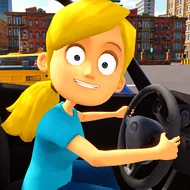





Teach My Little Sister How To Drive is a comedy driving simulator with a twist that changes everything: you never drive. You sit in the passenger seat next to your younger sister, who has just earned her license, and the only way to influence what the car does is to talk to her. She hears you, answers out loud and then decides for herself what to do with the gas, the brake and the wheel. It is part driving lesson, part conversation and part disaster movie – and it is unlike any other car game on PC.
- You ride in the passenger seat and guide your sister by voice alone
- She replies in real time with no fixed script and remembers what you say
- Lessons run from driving school courses to real roads with hazards
- Twelve languages are supported with full voice acting and subtitles
- A Windows PC release on Steam is planned for January 2027
A Driving Game Without a Steering Wheel
Every racing and driving game you have ever played puts the controls in your hands. This one deliberately takes them away. The car belongs to your sister: she buckles up, turns the key, presses the pedals and steers. You get a view from the passenger seat, the ability to look around, and a microphone.
That swap turns a familiar genre inside out. In a normal driving game, a missed corner is your fault and your reflexes fix it. Here, a missed corner is a communication problem. Maybe you spoke too late. Maybe you said too much, or too little. Maybe she understood perfectly and simply did something else.
The result is a game where the hardest skill is not driving but explaining. Anyone who has ever tried to teach a family member to drive, use a phone or assemble furniture will recognize the feeling within the first minute.
It also makes it accessible in an unusual way. You do not need fast fingers or racing experience. You need patience, clear words and a sense of humor – and the last one is the most important.
What a Session Feels Like
A lesson begins quietly. The car is parked, the engine is off and your sister is waiting for instructions. Even this first step can become an adventure, because she might agree to do something and then forget, or answer a question you did not ask.
Once the car is moving, the rhythm becomes a back-and-forth. You describe what is coming, she responds, the car reacts, and you adjust. When it works, it feels genuinely satisfying, like watching someone you coached finally get it right. When it fails, it fails spectacularly, with crashes that are deliberately over the top.
The emotional arc of a session is what makes it memorable. Early frustration gives way to small victories, then a sudden mistake, then laughter. Many players describe finishing a lesson more tired than after a hard boss fight, simply because staying calm took so much effort.
And at the end, it has a sense of humor about itself. Even a chaotic, cone-scattering run can finish with a cheerful DRIVE COMPLETE! message, as if nothing unusual had happened.
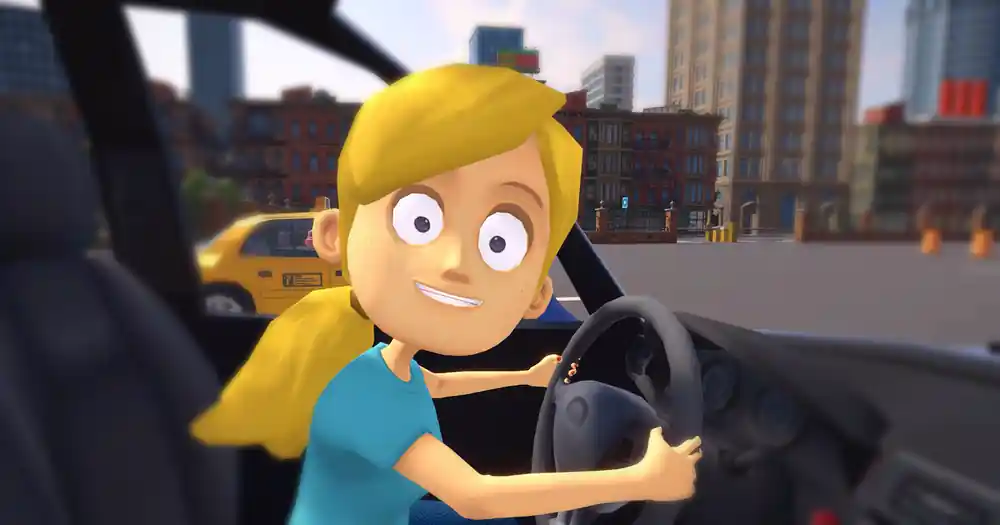
The Sister Behind the Wheel
Your sister is the whole reason this exists. She is not a voice reading prepared lines but a character who reacts to whatever you say in the moment. Ask her something about the road and she answers; ask her something completely unrelated and she will happily follow the tangent.
She always has something to say, even when the road needs her full attention.
She answers criticism with sharp, often hilarious comebacks.
A harsh tone makes her sulk; kindness makes her cooperative.
She remembers the conversation, so her attitude builds over the course of a lesson. A friendly instructor tends to get a more willing student. A mocking one may hear their own words thrown back at them at the worst possible moment.
Her look can be customized, including her outfit, and you are invited to make her resemble yourself. That small personal touch makes the family relationship at the center of the story feel a little more real – and the arguments a little funnier.
From Cones to Real Traffic
The game follows the structure of a real driving education. It starts on enclosed training courses, where the only obstacles are cones, gates and painted lines, and gradually moves onto proper roads. As your sister gets more capable, there is more to teach her, and the situations become more demanding.
| Stage | Main challenge | Lesson |
|---|---|---|
| Getting started | Seatbelt, ignition and the first slow meters | First Lesson |
| Curves | Turning and straightening on time | S-Curve Course |
| Precision | Lining up for a narrow opening | Gate Course |
| Parking | Tiny movements in tight spaces | Parking Lessons |
| Real roads | Traffic, junctions and sudden dangers | Real Roads |
The progression is gentle in theory and chaotic in practice. Even the simplest course can go wrong in creative ways, and the most complex road situation can go surprisingly smoothly if you and your sister are in sync.
The developers promise that anything can happen on the road, from simple curves to unexpected emergencies. That unpredictability is a design goal rather than a bug: no two drives play out the same way, even on the same course.
How It Compares to Other Driving Games
It helps to see how differently this title approaches the genre. Most car titles ask how fast or how precisely you can drive. This one asks how well you can communicate under pressure.
| Feature | Typical driving game | Teach My Little Sister How To Drive |
|---|---|---|
| Who controls the car | You | Your sister |
| Main input | Keyboard, mouse or gamepad | Your voice |
| Main skill | Reflexes and racing lines | Clear, calm instructions |
| Outcome of a crash | Restart and try again | An argument, then try again |
| Replay value | Better times and scores | New conversations every time |
| Tone | Competitive | Comedic and personal |
That comparison explains why it appeals to people who rarely pick up anything with a steering wheel. You do not need to know anything about cars to enjoy it, and experienced racers often find their skills surprisingly useless when someone else is holding the wheel.
If you want to compare it with titles that share some of its ideas – voice-controlled games, chaotic driving comedies or AI characters you talk to – our page of similar games to try groups them by what they have in common.
Why Miscommunication Is the Fun Part
At first, every misunderstanding feels like a failure. After a while, you start to realize that the misunderstandings are the point. The space between what you meant and what she heard is where all the comedy lives, and the whole experience is built around that gap rather than trying to hide it.
Some mix-ups are small and charming: a cheerful promise that she has done something she clearly has not, or a sudden question about a topic that has nothing to do with the road. Others are dramatic, like a wrong turn that ends with the car somewhere no car should be. Both kinds make a story you will want to tell someone afterward.
This is also why it stays interesting long after you understand its rules. A normal racer becomes predictable once you master it. A conversation with someone who has her own ideas never quite does.
Surprises for New Players
- Getting ready takes real time. Before the car moves at all, you may spend several minutes just on the seatbelt and the engine.
- Short words are risky. A single “go” can be read as permission to do much more than you intended.
- Long speeches do not help. Explaining everything in detail tends to confuse her more than a simple sentence.
- “Okay” does not mean done. She often sounds certain even when nothing has changed.
- Your tone is part of the controls. Speak sharply and her mood, and her driving, gets worse.
- Crashes are enormous. The physics lean into slapstick, with fires and explosions that are hard not to laugh at.
None of these surprises is a flaw once you know about it. They are the rules of something that happens to be played through conversation, and learning them is the first real milestone of every new instructor.
Four Ways to Play
Calm, encouraging and methodical. Lessons move slowly but steadily, and the sister becomes a surprisingly capable driver.
Teasing, provoking and playing for laughs. Expect arguments, sulking and spectacular crashes.
Testing strange instructions and odd questions to discover how she responds. Every session uncovers something new.
Playing for an audience, with chat suggesting what to say next. The lesson becomes a live show.
Most people drift between these styles depending on their mood. A calm session one evening can be followed by a deliberately chaotic one the next, and the game supports both without punishing either.
A Family Story at Its Core
Beneath the chaos sits a very ordinary situation: an older sibling trying to help a younger one with something new and scary. That familiarity is a big reason why it connects with so many people. The bickering, the teasing and the occasional moment of pride all feel like real family dynamics.
The official description even jokes that if you fail to teach her properly, your survival cannot be guaranteed. It frames the whole adventure as a test of the relationship as much as a test of driving.
That framing gives every successful lesson a warm edge. When she finally takes a corner perfectly because you explained it well, the satisfaction comes from teamwork rather than a high score.
Look and Sound
Visually, the game goes for a bright, cartoonish 3D style rather than realism. You spend most of your time in a first-person view from the passenger seat, watching the road through the windshield and turning your head to check what is happening around the car. The cute character design keeps even the most violent crash firmly in comedy territory.
Sound matters just as much as visuals, because her voice is the main feedback you get. Every reply is fully voiced in the language you choose, so the conversation flows naturally instead of forcing you to read subtitles while the car drifts toward a wall.
The 1.2.0 update rebuilt every vehicle and refreshed the main assets, which gave the cabin and the roads a cleaner, more finished look.
What the Community Debates
A title built on an unpredictable character naturally sparks discussion. The biggest debate is about accuracy. Some players wish she followed instructions more reliably, especially when she turns the wrong way or replies at great length. Others argue that a more obedient sister would lose exactly the chaos that made it famous.
A related concern is freedom of conversation. Part of the community worries that future versions might limit what she can say, while the team has said it wants her to feel like a living character rather than a one-joke meme.
Technical stability comes up too. Players have reported crashes on launch and long loading screens in the past, and the 1.2.0 update addressed a range of loading bugs. As the full release approaches, polish is the area most players are watching.
Who Will Enjoy It
- Love comedy and unscripted moments
- Enjoy talking to characters
- Stream or record your sessions
- Play with friends watching
- Want something genuinely new
- Want precise, reliable controls
- Prefer silent, solo sessions
- Have no microphone or stable internet
- Get frustrated by unpredictable outcomes
The game rewards a particular mindset. Players who treat each mistake as part of the story tend to have a wonderful time. Players who want every instruction followed exactly may find their patience tested in ways nothing else has managed.
It is also a social game in spirit, despite being single-player. Friends on the couch shouting their own suggestions, or a stream chat arguing about the right command, make the experience even louder and funnier.
Some people approach it as a challenge of self-control, trying to finish a whole lesson without raising their voice. Others play it as a comedy sketch and push every button they can find. Both approaches are equally valid.
Why It Became a Hit
The idea of shouting directions at a sister who will not listen proved irresistible to streamers. In September 2026, it spread rapidly through Japan’s VTuber community, and the number of people playing it grew more than twentyfold in a month. Its moments are short, self-explanatory and endlessly shareable.
It also found recognition at Tokyo Game Show 2026, where it was featured in the Selected Indie 80 area and drew crowds of people watching players talk to their sisters. The Steam page lists further recognition from Sense of Wonder Night and a Pocky Award.
Behind the success is a small team from South Korea that built the whole concept around one bold idea and then committed to it fully.
What You Need and When It Arrives
The game is coming to Windows PC through Steam, with a planned release in January 2027. Earlier plans pointed to late 2026, and the extra time is going into polish. Update 1.2.0 already remade the cars, refreshed the visuals and added appearance options for your sister.
- A Windows 10 or 11 PC with mid-range gaming hardware
- A microphone, because your voice is the only control
- A stable broadband connection for real-time conversation
- Your strongest language among the twelve supported
The supported languages are English, Japanese, Korean, French, German, Russian, Simplified and Traditional Chinese, two versions of Spanish and two versions of Portuguese, all with full audio. The release timeline is tracked in Release Date and Platforms.
Where to Start on This Site
This fan site is organized into four sections, each covering a different side of the sisterly driving lessons. If you are new, the Guides section is the natural starting point; if you already know the basics, the Courses section helps with specific lessons.
First steps, voice commands, staying calm and technical setup.
Walkthroughs for the S-curve, gate, parking and real road lessons.
Her personality, her off-topic chats and how her replies are generated.
Release plans, updates, the streaming wave and similar games.
You will also find a catalog of driving, parking, simulation and comedy games that share some of its spirit, from careful physics challenges to chaotic road trips.
Can I control the car myself?
No. Your sister performs every action in the car. Your role is to guide her with your voice and to look around from the passenger seat.
Does every lesson play out the same way?
No. Her replies are generated in real time, so conversations and reactions change from one attempt to the next, even on the same course.
Can I play with friends?
It is a single-player game, but it is very popular to play with friends or an audience watching and suggesting instructions.
Which languages can I speak to her in?
Twelve languages are supported with interface, full audio and subtitles, including English, Japanese, Korean, Chinese, Spanish, Portuguese, French, German and Russian.
Is there a story?
The premise is your sister’s first driving lessons after getting her license. The story that unfolds is mostly the one you create together through conversation – and through the crashes along the way.
Teach My Little Sister How To Drive takes the simplest premise imaginable – a sibling teaching a sibling – and turns it into one of the most original ideas in recent indie games: a car you cannot touch, a sister who never stops talking, and a microphone that becomes the most stressful controller you have ever held.
Comments
There are no reviews yet. Be the first one to write one.